



 Cart


 POPULAR CATEGORY


Leisure Battery Keeps Going Flat? Why It Happens and What to Buy
Your caravan’s 12V cuts out minutes after you unplug the hook-up, or the leisure battery is flat whenever you come to use it. Check three things: whether it ever reaches a full charge, whether something drains it while parked, and whether it is too small or worn out.
The Leisure, Marine, Industrial & Renewable Batteries range at PartsForMachines lists 348 batteries from Rolls, Victron, Exide, Numax, Sonnenschein and Lucas. Types include lead-acid, AGM, gel, lead carbon and lithium.
Why Does My Leisure Battery Keep Going Flat?
It is likely to be undercharged, drained while parked, or losing capacity. A lead-acid battery that rarely gets a full charge, or sits discharged for days or weeks, deteriorates through sulphation. Alarms, trackers and other standby loads draw current constantly, so a long lay-up can flatten it.
To find out, charge it fully, rest it off charge for at least four hours, ideally a day, then measure: a full 12V lead-acid battery reads about 12.7V. If it reads full but still dies soon after you unplug, it has lost capacity or is too small for what you run.
How Many Amp-Hours Do I Need, and How Low Can I Run It?
Work out what you use between charges, then choose a lead-acid battery about twice that size, because it should only be run down to about half. For each appliance, multiply its current in amps by the hours you use it, add them up, then multiply by the days between charges.
So a 75Ah lead-acid battery gives about 37Ah of use; regular deeper discharges cut its cycle life. Lithium can be run much deeper: Rolls, for example, quotes 6,000 cycles at 80% depth of discharge for its 12V S-Series lithium batteries. A watt-hour figure shows the total energy, useful for working out run times: the EP800 dual AGM battery (12V 95Ah) is rated at 800Wh.
AGM, Gel, Wet or Lithium: Which Suits Your Caravan, Motorhome or Boat?
If you are mostly on hook-up, a standard lead-acid battery will do; off grid, you need one built for repeated cycling. AGM’s low internal resistance suits heavy loads such as inverters, thrusters and winches, and it self-discharges less than a wet battery.
Gel is built for cycling and long rest periods, as in the ES1200 gel battery (12V 110Ah, NCC Class A). Victron rates its own gel range above its AGM range for deep-cycle durability. Lithium gives the most usable capacity and, unlike lead-acid, does not need a full charge to stay healthy, but needs suitable charging.
Can I Swap My Leisure Battery for Lithium?
Yes, as long as the battery has a battery management system (BMS) and every charging source suits lithium. Some, such as the BAT512110710 100Ah lithium SuperPack, have the BMS and a safety switch built in; others, such as Victron’s Smart batteries, need an external BMS.
Check that your mains charger and solar controller can handle a LiFePO4 charge profile; sealed lead-acid chargers may not suit. On the road, a smart alternator’s voltage varies, so a basic split-charge relay can leave the leisure battery undercharged. A DC-DC charger gives a fuller charge with the right profile for lead-acid or lithium.
What Should I Check Before I Buy?
- how you use it: mostly on hook-up or off grid, and your daily amp-hours
- whether it must also start an engine, or only run equipment
- capacity (Ah), NCC class and watt-hours where given
- the technology, and that your mains charger, solar controller and split-charge system all suit it
- length, width and height including terminals, plus terminal type, against your battery box
Browse the Leisure, Marine, Industrial & Renewable Batteries range, or contact the PartsForMachines team by WhatsApp, telephone or email with the details from your old battery’s label and how you use it.
Product options, delivery options and returns terms are shown on each product page. A 30-day return policy applies to eligible items.
Frequently Asked Questions
What does NCC class mean on a leisure battery?
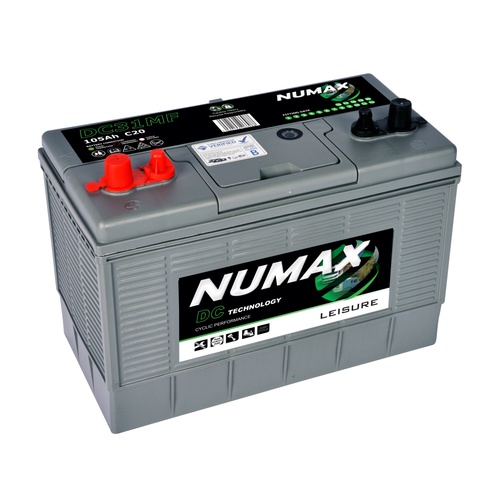
It is the National Caravan Council class, set by how many discharge and recharge cycles a battery manages when run down by up to 50% between charges. Class A is the highest; the DC25MF is Class B and the LV26MF Class C.
Can a leisure battery start an engine as well?
A dual-purpose one can. The DC25MF dual-purpose leisure battery (12V 105Ah) is rated 850A CCA for engine starting as well as auxiliary power. A bank that only runs lights, pumps and electronics is better served by a cycling design than a starter battery.
How long does a leisure battery last?
It depends on depth of discharge, charging and temperature. Victron quotes a design life of 7 to 10 years for its AGM batteries and 12 years for gel. If an older battery runs out noticeably sooner on a full charge, it is wearing out.
My leisure battery fell to 10V in storage. Is it finished?
Possibly. At 10V it is deeply discharged. Recharge it fully, rest it, then check the voltage and whether it still runs your usual loads for as long as it did; if not, replace it.
Why did my new battery fail after a winter in storage?
Left part-charged, or worse fully discharged, through a winter lay-up, a lead-acid battery fails early through sulphation. Charge it fully before storage, then recharge it every few months or keep it on a maintainer, and switch off standby loads you do not need.
Will a split-charge relay drain my leisure battery into the van battery?
It should not. A split-charge relay links the batteries only while charging, then separates them; a voltage-sensing type, for example, disconnects below float level. With a smart alternator, a DC-DC charger is the better choice.
Should I use two 6V batteries instead of one 12V?
You can, if your box has room. Two 6V batteries wired in series make a 12V bank. The US2200 6V deep-cycle battery (232Ah) is built for golf carts, floor cleaners and access equipment, and also for RV and solar use, but stands 286mm tall.
Does a caravan solar panel need a regulator?
You should fit one: feed the panel through a solar charge controller (regulator) set for your battery type, not straight to the battery. One controller, for example, offers flooded, AGM, gel and LiFePO4 settings, but its lithium setting needs a battery with an internal BMS.
What is a lead carbon leisure battery?
It is a lead-acid battery with a lead carbon negative plate, which can reduce sulphation when it often sits part-charged and improve charge acceptance. That suits off-grid and solar storage, where charging is often incomplete. The BAT612110081 (12V 106Ah) is one example.
Can I get more capacity in the same battery box?
Sometimes. Compare length, width, height and terminals, not just Ah: the DC25MF (105Ah) and EP800 (95Ah) share a 353 × 175 × 190mm case, while the ES1200 gel, at 230mm tall, needs more height. Lithium also gives more usable capacity for each amp-hour.


