



 Cart


 POPULAR CATEGORY


Anti-Vibration Spring Mounts: Stop the Hum, Rocking and Walking
Your fan, chiller, generator or compressor still hums through the floor on its mounts, rocks at start-up or creeps across the slab. Often the springs do not suit its weight and running speed, or were never levelled and fixed down.
PartsForMachines offers 105 spring mounts and related isolators from AV Industrial Products, including 74 open, enclosed and hanging spring units.
Spring or Rubber Mounts: Which Will Stop the Hum?
For fans, pumps, chillers and slow-running plant, springs are usually the better choice. A steel spring compresses much further under load than rubber, and that extra deflection (how far the mount squashes) is what isolates low-frequency vibration.
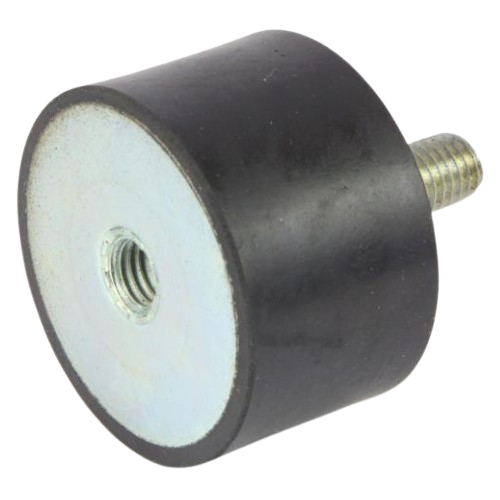
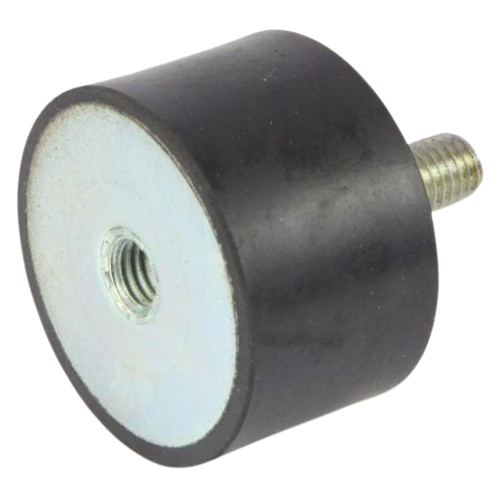
If the unit came on springs, refit springs: a thin rubber pad or hard puck barely compresses, so under a slow machine it may do little. Enclosed mounts such as the ESS20/70 enclosed spring mount, rated 70kg with up to 20mm of deflection, also carry snubbing rubber to limit movement at start-up and shut-down.
How Much Should a Spring Mount Deflect for My Machine’s Speed?
The slower the machine runs, the further its springs need to compress under its weight. Every machine bounces on its springs at a natural frequency, and more deflection lowers it. To isolate, the slowest running speed must sit far above that bounce frequency; near it, the springs magnify the shaking instead.
A spring also gives its full deflection only near its rated load. The OSMHD200-B open spring mount deflects 25mm at 200kg, but on a 100kg corner it compresses far less and isolates less. So work out the load on each foot, as the heavier end may need stronger springs.
Machine Rocking or Walking on Its Springs: How Do I Level and Fix It?
Fix each mount to the floor or frame and the machine to the mount tops, then adjust until it sits level with every spring evenly compressed. Anchoring stops running forces shifting it across the slab, and level springs share the load evenly.
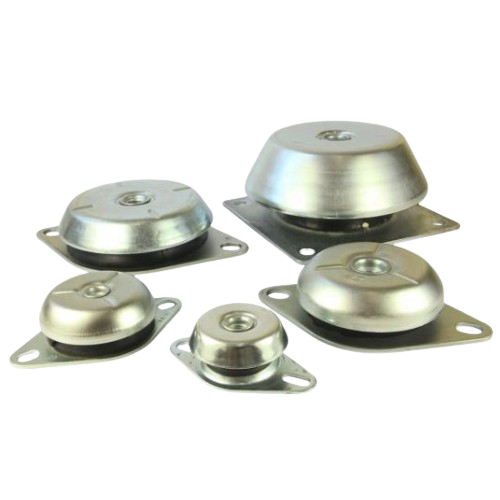
Enclosed mounts such as the ESM25/100 enclosed spring mount come with a top fixing bolt for levelling once installed. Open Type B and C mounts have slotted bases for bolting down. Check the machine’s manual too, in case its maker specifies the fixing.
Hanging a Heater, Fan or Duct: Will Spring Hangers Stop the Hum?
They can, if every drop rod has a spring hanger, so the whole weight passes through the springs and nothing rigid bridges them. Size each hanger for the load on its own rod.
The TM100 spring hanger takes up to 100kg with 24mm of deflection in a 75mm housing, and the range runs from the 25kg TM25 to the 350kg TM350, which allows 35mm.
Keep each rod clear of its hanger box, as metal-to-metal contact passes vibration straight on, and fit flexible pipe and duct connections. Allow for the unit dropping as the springs compress, and get a qualified installer to check gas and flue connections.
What Should I Check Before I Order?
- the weight on each mounting point and the machine’s slowest running speed
- the deflection each spring gives at that load, not just its maximum rating
- the fixing: thread size (M8 to M16) and the base hole or slot against your frame and floor
- the height under load against the space, pipework, ducts and cables
- how the unit sits: on the floor (open or enclosed mounts), hanging from rods (spring hangers) or fixed to a wall (suspended mounts)
Browse the Spring Mounts range, or contact the PartsForMachines team by WhatsApp, telephone or email with the machine’s weight, running speed and fixing layout.
Product options, delivery options and returns terms are shown on each product page. A 30-day return policy applies to eligible items.
Frequently Asked Questions
Why has the vibration got worse since fitting spring mounts?
Often the machine’s bounce frequency on the springs sits too close to its running speed, so the mounts amplify instead of isolating. Springs that are too stiff or too lightly loaded can cause it.
Will spring mounts work on a mezzanine or upper floor?
They can, but the frame under the machine must be rigid in its own right, because on springs the floor no longer stiffens it. Ask a structural engineer before isolating heavy plant on an upper floor or mezzanine.
The spring mounts are taller than the old feet: what should I allow for?
Compare overall heights first: 63mm for the ESS20/70 and 89mm for the ESM25/100, for example. Then check the clearance around and above the machine, and give pipes, ducts and cables enough slack to move.
The unit is isolated, but its pipework still drums on the wall or roof: what next?
The pipe run is probably carrying the vibration. Fit a flexible connector close to the unit and support the run on isolating hangers rather than rigid clips. Spring hangers suit ducting and pipework runs.
How do I isolate a cabinet or panel hung on a wall?
Use upper and lower suspended mounts together: the upper one takes the hanging load at the top fixing and the lower one the compressive load at the bottom. The HNG-upper-60 suspended mount, for example, has an M8 thread and 96mm hole centres.
Open or enclosed spring mount: which do I need?
Choose enclosed if the machine needs holding against sideways movement: mounts such as the ESS20/70 keep the spring in a steel cup that limits it. Our open mounts come as Type A (M8 top thread), B (top thread, slotted base) or C (slotted base only).
What happens if a spring mount is overloaded?
It can bottom out, with the coils pressed together until they touch. Choose a rating just above the real load on each mount, and check that no coils touch at start-up or while the machine runs.
Are hollow rubber springs the same as spring mounts?
Not quite. They work mainly as suspension and assister springs on vehicles, trailers and plant, and they stiffen progressively as they compress. Each has more than one rating: the HRS5556 carries 110kg as a suspension spring and 300kg as an assister.
Are stainless or oil-resistant versions available?
For many of these mounts, yes. Stainless metalwork and oil-resistant or high-temperature rubber can be supplied on request; contact our team with the part number and the conditions the mount will work in.


