



 Cart


 POPULAR CATEGORY


Rubber Bump Stop Coming Off Its Plate? Glue, Cut Down or Replace
A bump stop that has split from its plate, gone hard or sits at the wrong height lets metal hit metal and sends shocks into the frame. Usually the fix is a like-for-like replacement, matched on fixing, height and load.
PartsForMachines lists 517 rubber buffers and bump stops from AV Industrial Products, from small threaded buffers to heavy plate buffers and buffers for Hamm rollers.
Bump Stop Rubber Coming Away From the Plate: Can I Glue It Back?
It makes sense to replace it rather than glue it. On a bonded buffer the rubber is vulcanised onto the metal when the part is made, and a joint glued on the bench is unlikely to match that bond under repeated knocks.
Most buffers in our range are made this way, with the rubber bonded to the metal. Catch failures early: look for a gap or crack along the line where rubber meets metal, or rubber that shifts on the plate when you push it. Check the other stops while you are there.
Can I Cut Down, Stack or Remove a Bump Stop?
Fitting a buffer of the right height is better than cutting, stacking or removing one. A bump stop limits travel and prevents metal-to-metal contact, and its force rises as the rubber compresses. Cutting it down removes rubber that does the cushioning, stacking adds a joint that can work loose, and removing it lets the axle or arm bottom out.
Heights vary, so a closer match usually exists: our square plate buffers alone run from 32mm (PB50) to 160mm (PB250). For a softer start, the 4335MFBT27 tapered buffer is 35mm high on an M10 stud and stiffens gradually as it deflects.
Male Stud, Female Thread, Flat or Tapered: Which Buffer Fits My Job?
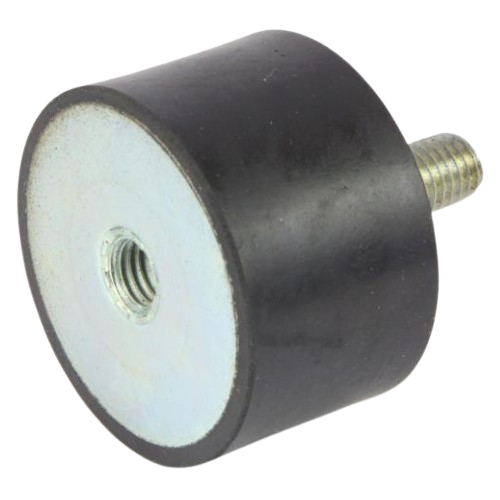
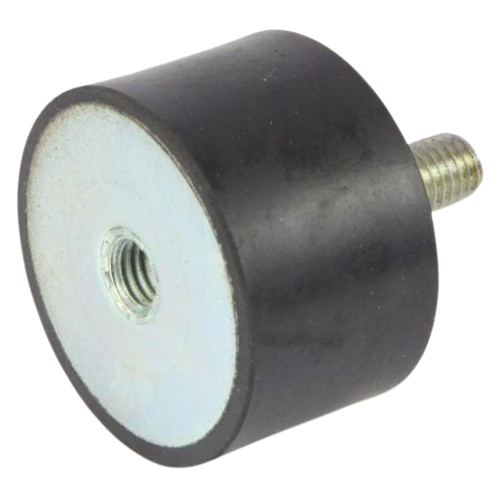
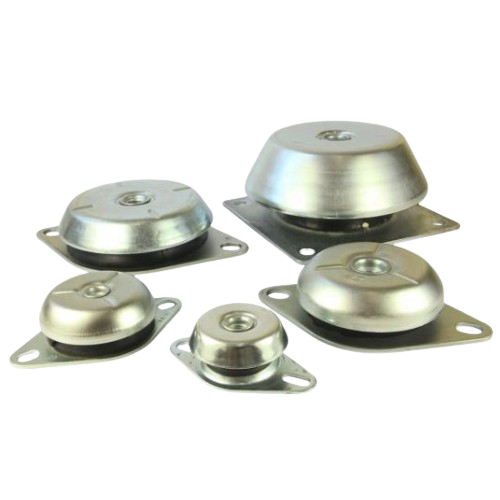
Match the fixing first, then the shape. Male buffers carry a threaded stud, female buffers have a threaded hole, and plate buffers bolt through holes in a steel flange. The 1510FFB04-55 female flat buffer is 15mm across and 10mm high on an M4 thread, rated 35kg at 2.5mm deflection.
Then match the shape of the old part: flat, conical or tapered. Where the stop bolts to a flat panel, the BS truck buffer is a 60mm-diameter stop, 125mm long and 15mm high, with two fixing holes. Clear away any old cups or brackets so the new stop sits flat.
Roller or Machine Buffers Cracked or Hard: Replace Them Even if They Look OK?
Yes: rubber that has gone hard or cracked no longer cushions as it should, even if it is still in one piece. Heat, oxygen and ozone all age rubber, leaving it brittle and cracked. Compare the old buffer with a new one, and look closely for fine cracks.
On rollers and compactors, match the OE number on the old part. The HAM-354082 rubber buffer replaces Hamm OE 354082 across many models, including the 2520 and DV8.4.
What Should I Check Before I Order a Buffer or Bump Stop?
- the fixing: male stud, female thread or plate with holes, plus the thread size
- the height and diameter of the old buffer, measured where it is not squashed
- the load it must stop and the deflection at that load
- the shape: flat, conical or tapered, matching the old one
- any OE number on the old part, and whether oil, fuel or heat reach it
Browse the rubber buffer and bump stop range, or contact the PartsForMachines team by WhatsApp, telephone or email with a photo and measurements of the old part, and we will help you match it.
Product options, delivery options and returns terms are shown on each product page. A 30-day return policy applies to eligible items.
Frequently Asked Questions
Is a dearer bump stop worth it if they look the same?
It can be, because the differences are hidden in the rubber compound, the bond and the metalwork. Many of our buffers can be made with stainless steel metalwork, or oil-resistant or high-temperature rubber, on request for harsher conditions.
Does 45, 60 or 70 Shore change how much a buffer will stop?
Yes, harder rubber takes more load for the same squash. At 23mm deflection the 100100MCB31 conical buffer carries 220kg in 45 Shore, 440kg in the 100100MCB31-60 conical buffer and 660kg in 70 Shore.
Is a threaded rubber buffer worth it over a grommet and screw?
For repeated knocks, usually yes. On a threaded buffer the rubber is bonded to a metal base carrying the stud or thread, so the fixing does not rely on a screw through the rubber. For light, occasional contact a grommet may do.
What thread sizes do rubber buffers come in?
Our range runs from M3 studs on small 8mm buffers up to M16 on heavy male buffers. Measure the stud or hole diameter and the thread length on the old part before you order.
Is it a bump stop or a spring helper?
A bump stop only works at the end of travel, when a moving part meets it, absorbing the impact. If the rubber carries load all the time, it is acting as a spring or mount, so describe the job when you ask us.
Should I replace bump stops in pairs?
It makes sense to. A hard or split stop on one side cushions less than a new one on the other, so fit matching buffers on both sides and check them together.
How do I fit a plate-mounted buffer like a truck buffer?
Clean the mounting face so the plate sits flat, then bolt it through its fixing holes. The BS truck buffer has two, 20mm and 8mm across, and can work in compression, shear or both.
My old buffer has an OE number: will a matched part bolt straight in?
It should, if the OE number matches. The HAM-1487116, for example, is built to the original form and fit of OE 1487116, with no modification needed. Check the number on your old part first, and ask our team if you are unsure.
Which buffers suit heavy impact loads?
Square plate buffers, which bolt down through four holes in a steel flange. They range from the PB50, rated to 1,530kg, up to the PB250, rated to 38,220kg with a 200mm square plate.


