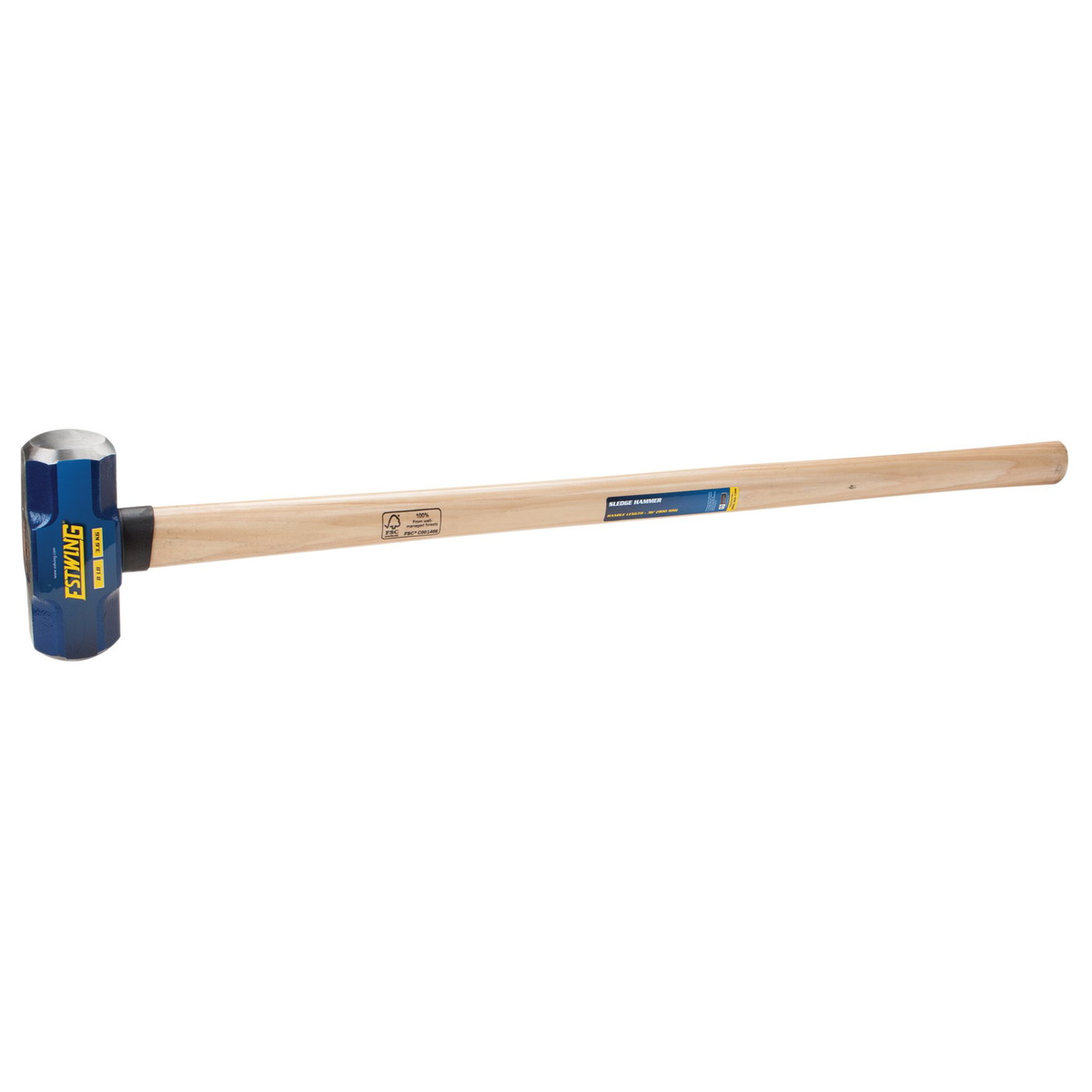
Head weight on a sledge hammer is chosen against what the user can swing repeatedly rather than what will break the material fastest. A 14lb head does more per blow than a 7lb head and delivers far fewer blows before the arms give out. Overall length is the other half of that calculation, since a longer shaft multiplies what a given head does.
The range runs 1.8kg and 4lb at the light end, through 2.7kg, 3.2kg, 3.6kg, 4.5kg and 10lb, up to 5.5kg, 6.3kg, 14lb and 16lb. The lighter heads are for driving stakes and breaking small material; the heavy end is demolition. Reading both figures together is what separates a hammer that can be used all day from one that cannot.
Shaft material is the second decision and it is about shock and survival. Fibreglass absorbs vibration and does not rot, split or dry out, which suits a hammer left in a van or outdoors. Hickory is traditional, flexes well and can be replaced when it breaks. Estwing hold ESH bodies in both shaft materials across most of the weight range.
One-piece forged hammers remove the head-to-shaft joint entirely, which is where a sledge hammer most often fails. Overall length is stated per hammer, and a longer shaft gives more head speed for the same effort. Send the material being broken to 07754288583 on WhatsApp. A hammer that fails at the joint is also the one most likely to release the head mid-swing.


 Filters






 Cart
Cart


 POPULAR CATEGORY


