


 Filters


Four ways of cutting share this leaf and they leave four different edges. A saw cuts a kerf and follows a line. A nibbler punches out a narrow ribbon, which lets it turn a tight radius without distorting the panel. Shears cut like scissors and are fastest in a straight line. A cut-off tool grinds through with a disc where the others cannot reach. Choosing between them is a decision about the edge you want to be left with, not about which tool is fastest.
Material thickness is what narrows the choice. Nibblers and shears are rated for sheet, and going beyond that rating stalls the tool rather than cutting slowly. Saws and cut-off tools handle section as well as sheet. The rating is stated per tool, so the material is measured before the tool is picked rather than after.
Blade and disc size follow. Cut-off tools here run 75mm discs, air files run 5mm belts, and reciprocating saw blades are matched to the tool that holds them. Blades are the consumable on this leaf and a blunt blade reads as an underpowered tool, which is worth knowing before a saw is judged. Sealey hold reciprocating and mini saws for bodyshop work, with air files covering the finish afterwards.
Body saws and mini reciprocating saws cover bodyshop work where the cut is short and awkward. The PCL Prestige body saw, nibbler and cut-off tools sit alongside the Sealey SA and Generation lines and the Chicago Pneumatic saws and shears. A photo of the material and the cut line over WhatsApp on 07754288583 settles which of the four is right. The Sykes 90231000 air saw sits with them for work where the cut has to be started away from an edge.


| Model No | S01005 |
|---|---|
| Air Consumption | 4cfm |
| Brand | Siegen |
|
Consumable Parts:Cutting Discs: PTC/3C (Single), PTC/3C5 (Pack of 5)
|
|
| Disc Size | Ø75 x 2 x 10mm |

| Model No | SA25 |
|---|---|
| Air Consumption | 6cfm |
| Brand | Sealey |
|
Consumable Parts:Cutting Discs: PTC/3C (Single), PTC/3C5 (Pack of 5)
|
|
| Disc Size | Ø75 x 2 x 10mm |

| Model No | GSA25 |
|---|---|
| Air Consumption | 6cfm |
| Brand | Generation |
|
Consumable Parts:Cutting Discs: PTC/3C (Single), PTC/3C5 (Pack of 5)
|
|
| Disc Size | Ø75 x 2 x 10mm |

| Working pressure | 90psi (6.2bar) |
|---|---|
| Average air consumption | 2.5cfm (78l/min) |
| Air inlet | 1/4" |
| Air hose size | 3/8" |
| Strokes per min | 10000 |

| ITEM NO | 01611 |
|---|---|
| No-Load Speed | 10,000spm |
| Stroke Length | 10mm |
| Av. Air Consumption | 6.00CFM (170ltr/min) |
| Steel Cutting Capacity | 1.2mm (16 GAUGE) |

| Average air consumption | 9.8cfm (278L/min) |
|---|---|
| Air inlet | 1/4" BSP |
| Air hose size | 3/8" (10mm) |
| Strokes per min | 3800spm |
| Length | 195mm |

| Air Inlet | 1/4" BSP |
|---|---|
| Average Air Consumption | 5cfm (141L/min) |
| Cutting Wheel Diameter | 75mm |
| Disc Size | 75mm |
| Free Speed | 20,000 rpm |

| Model No | S01045 |
|---|---|
| Air Consumption | 4cfm |
| Brand | Siegen |
| Consumable Parts | SA34/B14 - 14tpi Air Saw Blade (x5), SA34/B24 - 24tpi Air Saw Blade (x5), SA34/B32 - 32tpi Air Saw Blade (x5) |
| Free Speed | 10000spm |

| Model No | SA53 |
|---|---|
| Air Consumption | 4cfm |
| Brand | Sealey |
| Consumable Parts | SA53.V3-31 - Replacement Blade Outer Left, SA53.V3-30 - Replacement Blade Outer Right, SA53.V3-32 - Replacement Blade Centre |
| Inlet Size | 1/4"BSP |

| Air Inlet | 1/4" BSP |
|---|---|
| Average Air Consumption | 5.5cfm(1,132L/min) |
| Cutting Capacity | 18 Gauge (1.2mm) |
| Cutting Capacity (Mild Steel) | 18 Gauge (1.2mm) |
| Min Hose Size | 3/8" (10mm) |

| Model No | SA56 |
|---|---|
| Air Consumption | 4cfm |
| Brand | Sealey |
| Consumable Parts | SA56.31 - Replacement Blade Outer Right, SA56.32 - Replacement Blade Outer Left, SA56.33 - Replacement Blade Centre |
| Inlet Size | 1/4"BSP |

| Model No | SA28 |
|---|---|
| Air Consumption | 4cfm |
| Brand | Sealey |
| Consumable Parts | SA28PDKV2 - Replacement Punch & Die Set |
| Free Speed | 3000spm |
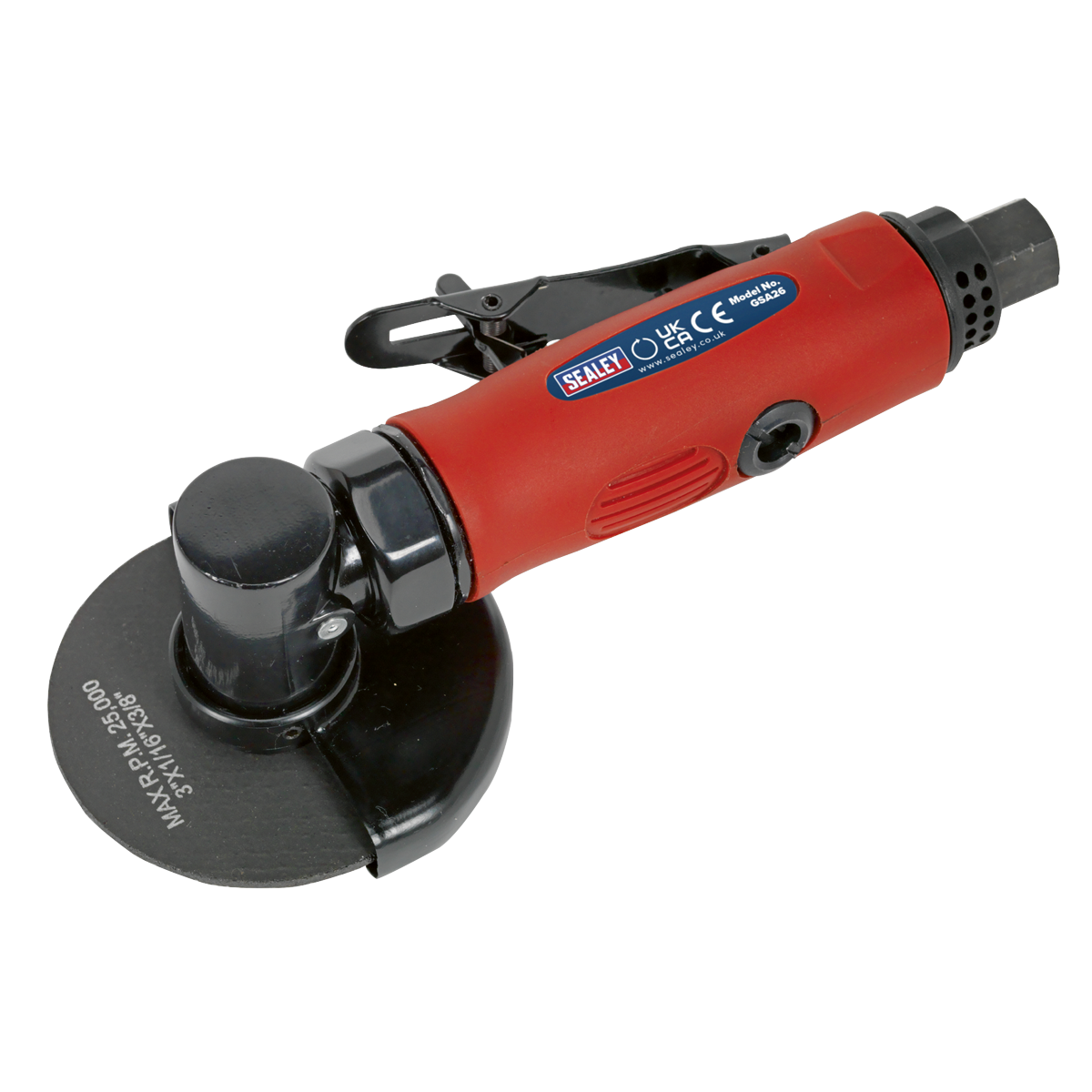
| Model No | GSA26 |
|---|---|
| Air Consumption | 4cfm |
| Brand | Generation |
|
Consumable Parts:Cutting Discs: PTC/3C (Single), PTC/3C5 (Pack of 5)
|
|
| Disc Size | Ø75 x 2 x 10mm |

| Flexible head | 0 |
|---|---|
| Guard positions | 0 |
| Wheel/Disc diameter (in) | 3 |
| Wheel/Disc diameter (mm) | 75 |
| Free Speed | 22000 rpm |

| Model No | SA342 |
|---|---|
| Air Consumption | 4cfm |
| Brand | Sealey |
| Consumable Parts | SA34/B14 - 14tpi Air Saw Blade (x5), SA34/B24 - 24tpi Air Saw Blade (x5), SA34/B32 - 32tpi Air Saw Blade (x5) |
| Free Speed | 9000spm |

| Model No | SA2501 |
|---|---|
| Air Consumption | 4cfm |
| Brand | Sealey |
|
Consumable Parts:Cutting Discs: PTC/3C (Single), PTC/3C5 (Pack of 5)
|
|
| Disc Size | Ø75 x 2 x 10mm |


| Model No | SA348 |
|---|---|
| Air Consumption | 3cfm |
| Brand | Sealey |
| Consumable Parts | SA34/B14 - 14tpi Air Saw Blade (x5), SA34/B24 - 24tpi Air Saw Blade (x5), SA34/B32 - 32tpi Air Saw Blade (x5) |
| Free Speed | 9000spm |

| Model No | SA650 |
|---|---|
| Air Consumption | 4cfm |
| Brand | Premier |
|
Consumable Parts:Cutting Discs: PTC/3C (Single), PTC/3C5 (Pack of 5)
|
|
| Disc Size | Ø75 x 2 x 10mm |

| Model No | SA649 |
|---|---|
| Air Consumption | 4cfm |
| Brand | Premier |
| Consumable Parts | SA649.41 - Replacement Punch, SA649.43 - Replacement Die |
| Free Speed | 3200spm |

| Model No | SA34 |
|---|---|
| Air Consumption | 6cfm |
| Brand | Premier |
| Consumable Parts | SA34/B14 - 14tpi Air Saw Blade (x5), SA34/B24 - 24tpi Air Saw Blade (x5), SA34/B32 - 32tpi Air Saw Blade (x5) |
| Free Speed | 10000spm |

| Brand | PCL |
|---|---|
| Shipping Weight (kg) | 0.838 |
| Product Weight (Kg) | 0.62 |
| Air Tool Type | Air Body Saw |
| Free Speed (rpm) | 9,000 |

| Flexible head | 0 |
|---|---|
| Guard positions | 0 |
| Housing material | Steel |
| Starting system | Safety lever |
| Wheel/Disc diameter (in) | 3 |

| Stroke per minute | 10000 |
|---|---|
| Sound Power | 82 dB(A) |
| Sound Pressure | 93 dB(A) |
| Uncertainty vibration-K | 5.2 m/s² |
| Length (L) | 216 mm |

| Model No | SA347 |
|---|---|
| Air Consumption | 4cfm |
| Brand | Premier |
| Consumable Parts | SA347.NF5 - Replacement Needle File Set |
| Free Speed | 7500spm |

| Product Dimenstions (L x W x H) | 165 x 90 x 70 mm |
|---|---|
| Product Weight | 0.595 Kg |

| Brand | PCL |
|---|---|
| Number | APP600 |
| capacity | 1.2 mm |
| Free Speed Weight | 0.65 kg |
| Vibration | 1.59 m/s |

| Main Material type | Aluminium |
|---|---|
| Starting system | Safety lever |
| Stroke per minute | 12000 |
| Sound Power | 88 dB(A) |
| Sound Pressure | 77 dB(A) |

| Main Material type | Aluminium |
|---|---|
| Stroke per minute | 10000 |
| Sound Power | 78 dB(A) |
| Sound Pressure | 89 dB(A) |
| Vibration (m/s²) | <2.5 m/s**2 |
By sharing your email, you agree to our privacy policy & terms of service


 Cart
Cart


 POPULAR CATEGORY


