




 Cart
Cart


 POPULAR CATEGORY


 ADD TO CART




| SERVICE | DELIVERY PRICE | DELIVERY TIME |
|---|---|---|
| Standard Delivery | £29.99 | 7 to 10 working days |
| SERVICE | DELIVERY PRICE | DELIVERY TIME |
|---|---|---|
| Standard Delivery | £29.99 | 7 to 10 working days |
| SERVICE | DELIVERY PRICE | DELIVERY TIME |
|---|---|---|
| Standard Delivery | £5.99 | 2 to 4 working days |
| Next Day | £15.54 |
| SERVICE | DELIVERY PRICE | DELIVERY TIME |
|---|---|---|
| Standard Delivery | £29.99 | 5 to 7 working days |
| SERVICE | DELIVERY PRICE | DELIVERY TIME |
|---|---|---|
| Standard Delivery | £29.99 | 7 to 10 working days |
Product Number: 04065
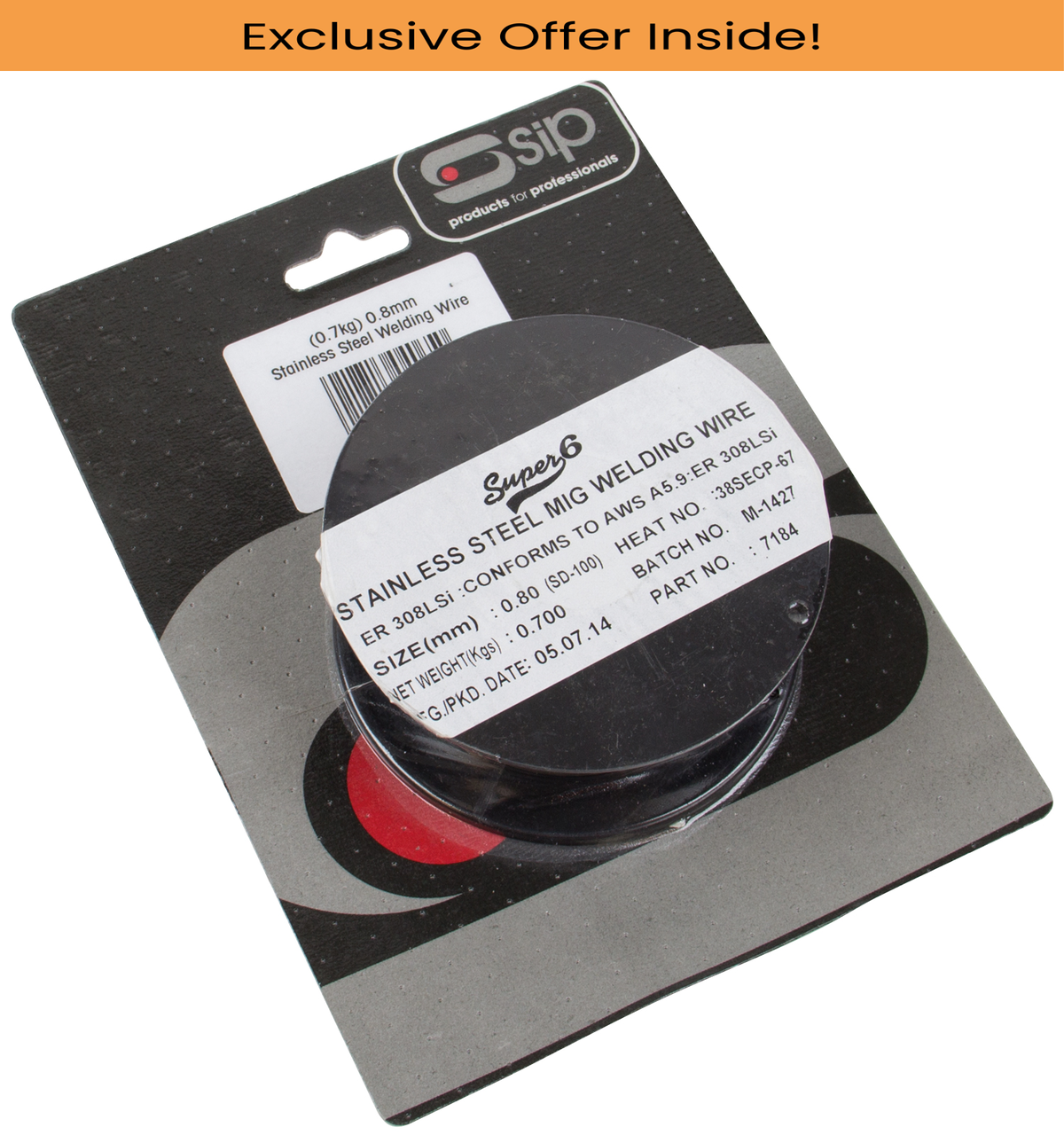
A Ø 0 — 80mm mig wire on a 0. 70kg spool, the SIP 04065 delivers consistent deposition in Stainless Steel MIG applications. An essential mig welding wire for any professional welding setup, stocked for fast UK delivery. Match contact tip bore to wire diameter and check your machine's spool capacity before ordering. Wire diameter selection depends on material thickness: 0 — 6mm for sheet under 1 — 5mm, 0 — 8mm for general fabrication from 1 — 5mm to 6mm, and 1. 8mm mig wire, welding wire spool, flux cored wire. Also referred to as a mild steel mig wire or 0 — 8mm mig wire in the welding trade.
Additional Information:
The SIP 0.7kg x 0.8mm Stainless Steel Welding Wire is manufactured to the highest standard using premium-grade steel, meaning this reel is perfectly suited for welding applications using gas, such as Argon and Argon mixes.About PartsForMachines:
PartsForMachines is a premier e-commerce platform, founded in 2019 in Warwickshire, UK, specializing in aftermarket parts and services for construction, agriculture, and industrial machinery. We offer an extensive catalog of over 500,000 products. Standard delivery: 1–3 working days within UK mainland. We are proud to be an authorised distributor, giving customers extra confidence when purchasing genuine products from us. In addition, we provide a 30-day return policy for eligible items.
| ITEM NO | 04065 |
|---|---|
| Wire Type | Stainless Steel |
| Wire Size | Ø 0.80mm |
| Wire Spool Size | 0.70kg |
| Engine Parts | Product Number | Product Name | Recommended Units | Product Price | |
|---|---|---|---|---|---|

|
05733 | SIP 05733 WELDMATE® 160A MIG/ARC/TIG Welder | 2-Year Standard Warranty | 1 Unit |
£215.22
£208.95
|
Add |

|
05737 | SIP 05737 WELDMATE® AUTOPLUS 130A MIG/ARC/TIG Synergic Welder | 1 Unit |
£262.71
£257.56
|
Add |
 Standard Delivery: £5.99
 Next Day Delivery Available
 Delivery Estimate: 2 to 4 working days
 Save Extra With 1 Offer
 Compare With Similar Items
Compare with Similar products
|
|||||||||||||||
| Technical Specification | |||||||||||||||
|---|---|---|---|---|---|---|---|---|---|---|---|---|---|---|---|
| PRODUCT NUMBER | 02689 | 02691 | 02692 | 02693 | 02777 | 02779 | 02666 | 02668 | 02669 | 02671 | 02678 | 02681 | 02706 | 04000 | 04010 |
| Type | Electrodes | Electrodes | Electrodes | Electrodes | Electrodes | Electrodes | Welding Wire | Welding Wire | Welding Wire | Welding Wire | Welding Wire | Welding Wire | Welding Wire | Welding Wire | Welding Wire |
| Size | 1.60mm | 2.00mm | 2.50mm | 2.50mm | 4.00mm | ||||||||||
| Weight | 5kg | 5kg | |||||||||||||
| Dia | 1.60mm | 2.00mm | 2.50mm | 2.50mm | 4.00mm | 0.6mm | 0.6mm | 0.8mm | 0.8mm | 0.8mm | 1.0mm | 0.8mm | 0.6mm | 0.8mm | |
| Pack Qty | 10 | 10 | 10 | ||||||||||||
| Reel | 5kg | 5kg | 5kg | 15kg | 5kg | 15kg | 0.9kg | 15kg | 4.5kg | 0.7kg | 0.45kg | ||||
| Size Range | Up to 10mm | Up to 10mm | Up to 10mm | Up to 10mm | Up to 10mm | ||||||||||
| Wire | Gasless/Flux | Gasless/Flux | Gasless/Flux | ||||||||||||
| Show More | |||||||||||||||
A. Compatible with: CROSARC CAP0253 and CAP0254 (and 2 more); Clarke 220A and MIG270DVMULTI; Draper 71095; SIP 05733 and 05737 (and 19 more) The spool size is the critical compatibility factor — check your machine accepts a 0.70kg spool before ordering.
A. Ø 0.80mm MIG wire is the all-purpose choice for material from about 1.5mm to 6mm thick. For thin sheet under 1.5mm, 0.6mm wire is more controllable. For heavier sections above 6mm, 1.0mm or 1.2mm wire with higher amperage is more productive.
A. Yes — always match contact tip bore to wire diameter. If you're moving to Ø 0.80mm wire, fit Ø 0.80mm bore contact tips. Running mismatched tip and wire sizes causes arc instability, burn-back and excessive spatter regardless of how well the machine is set up.
A. The SIP 04065 is wound on a 0.70kg spool. Check your machine's spool capacity in the specifications — compact and entry-level MIG welders often accept up to 5kg only. Industrial machines accept 15kg. Fitting an oversized spool risks damaging the wire feed mechanism.
A. Stainless MIG wire requires a tri-mix gas — typically 90% Argon/7.5% CO2/2.5% Helium ('Stainshield' type) or 98% Argon/2% CO2. Do not use standard CO2 or 75/25 mix — high CO2 causes excessive oxidation and spatter that compromises the corrosion resistance of the stainless weld.
A. ER70S-6 (US classification) and A18 (BS 2901) are equivalent grades of mild steel MIG wire — one of the most commonly used grades for structural and general fabrication. ER70S-6 has higher silicon and manganese content for better wetting on mildly contaminated surfaces. The SIP 04065 is Stainless Steel — suitable for general MIG welding of mild steel.
A. For Ø 0.80mm wire, start with your voltage at the mid-range for your material thickness (typically 16–20V for 3mm steel), then adjust wire speed until the arc sounds smooth with minimal spatter — like frying bacon. Fine-tune inductance if your machine has it: more inductance softens the arc for thin sheet; less gives a crisper arc for out-of-position work.
A. Yes — thicker wire typically requires higher voltage and current settings, which increases heat load on the machine and reduces available duty cycle. If you're running Ø 0.80mm wire at the top of your machine's output range, monitor torch temperature and allow adequate cooling intervals.
A. Check your machine's specification for the accepted wire diameter range (typically 0.6mm-1.2mm for MIG) or electrode diameter range (typically 1.6mm-4.0mm for ARC/MMA). The machine's output amperage determines the maximum electrode size it can run — higher amperage machines handle thicker electrodes.
A. Compatible with: CROSARC CAP0253 and CAP0254 (and 2 more); Clarke 220A and MIG270DVMULTI; Draper 71095; SIP 05733 and 05737 (and 19 more) Confirm your machine accepts a 0.70kg spool and uses a Ø 0.80mm bore contact tip before loading this wire.
By sharing your email, you agree to our privacy policy & terms of service
 Question about this product? Click here


