


 Filters


Key capacity is quoted as a hook count rather than a key count, and the difference matters. A key on a fob or with a second key attached occupies more than one hook's worth of depth, so a cabinet rated at 50 keys holds fewer than fifty vehicle keys. Counting the keys as they actually are, with fobs attached, is what gets the capacity right.
That is why deep and wide bodies exist at the same capacity. A deep cabinet at 375 x 140 x 550mm takes keys with fobs and alarms attached where a standard body would not close. The depth rather than the hook count is what accommodates them. Hook count is stated per cabinet, and depth is stated separately where it differs from the standard body.
Lock type decides how access is controlled. A tumbler lock is opened by a key, which means someone holds the key to the key cabinet. An electronic cabinet uses a code, which can be changed when staff change without replacing the lock. A code also leaves no physical credential to be copied or left in a drawer.
Capacity runs 20, 36, 45, 50, 93, 100, 200 and 300 keys across the range, with electronic bodies at 25, 50 and 100. Key tags in packs of 20 are what make a large cabinet usable rather than a wall of identical keys. Send the fleet or property count to 07754288583 on WhatsApp. Wide bodies at 100 and 200 keys spread the same capacity across a shallower cabinet.


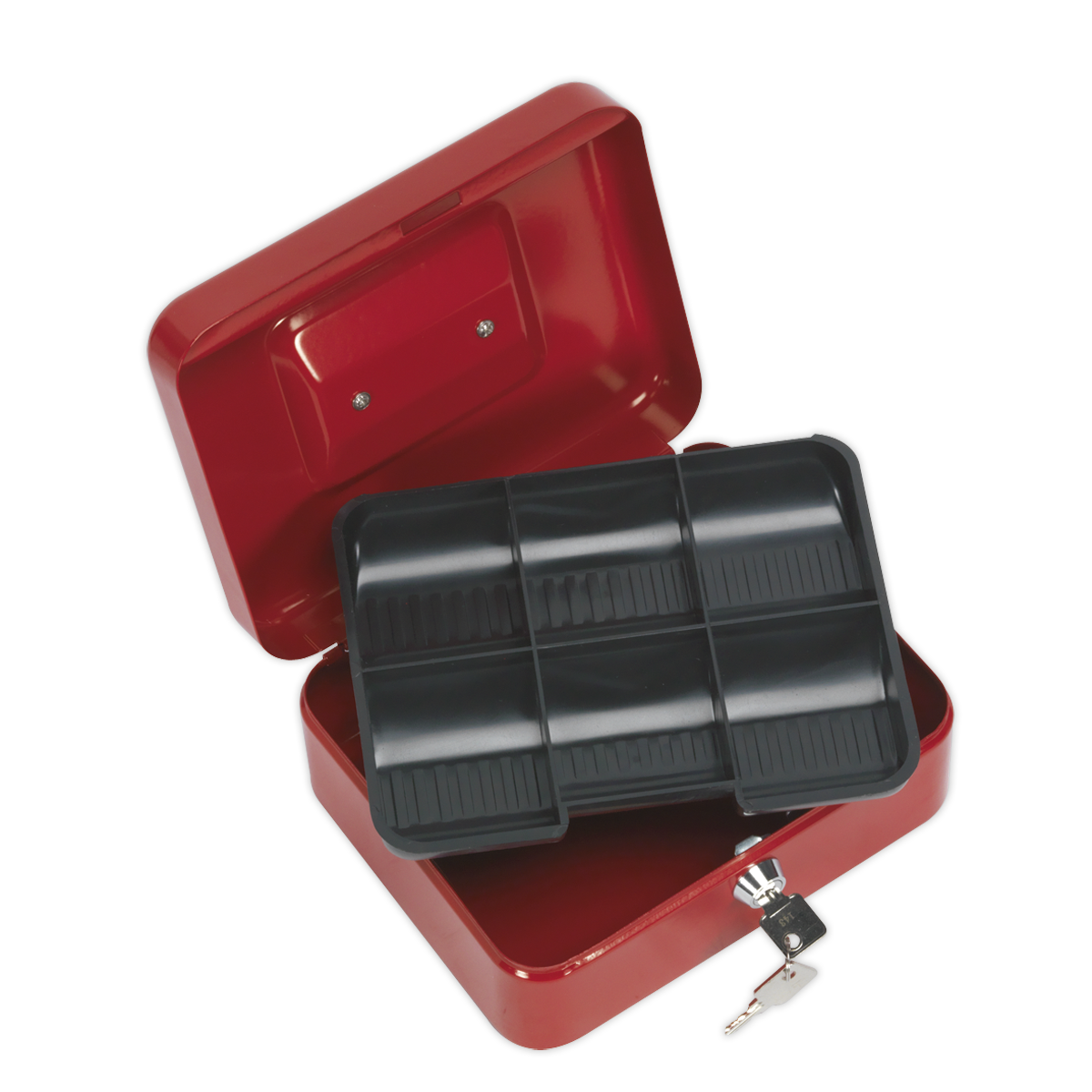
| Model No | SCB2 |
|---|---|
| Brand | Sealey |
| Nett Weight | 0.89kg |
| No. Coin Compartments | 6 |
| Overall Size (W x D x H) | 200 x 160 x 90mm |

| Overall size | 240 x 180mm |
|---|

| Dimensions | W 94 x H 114 x D 40mm |
|---|

| Model No | SKC20 |
|---|---|
| Brand | Sealey |
| Key Capacity | 20 |
| Nett Weight | 0.93kg |
| Overall Size (W x D x H) | 160 x 80 x 200mm |

| Model No | SKC820 |
|---|---|
| Brand | Sealey |
| Key Capacity | 20 |
| Nett Weight | 0.88kg |
| Overall Size (W x D x H) | 160 x 80 x 200mm |


| Model No | SKC45 |
|---|---|
| Brand | Sealey |
| Key Capacity | 45 |
| Nett Weight | 1.75kg |
| Overall Size (W x D x H) | 240 x 80 x 300mm |

| Model No | SKC836 |
|---|---|
| Brand | Sealey |
| Key Capacity | 36 |
| Nett Weight | 1.58kg |
| Overall Size (W x D x H) | 240 x 80 x 300mm |

| Model No | SKC93 |
|---|---|
| Brand | Sealey |
| Key Capacity | 93 |
| Nett Weight | 2.52kg |
| Overall Size (W x D x H) | 240 x 80 x 300mm |

| Model No | SKC50 |
|---|---|
| Brand | Sealey |
| Key Capacity | 50 |
| Nett Weight | 4.73kg |
| Overall Size (W x D x H) | 375 x 80 x 550mm |

| Model No | SKC100 |
|---|---|
| Brand | Sealey |
| Key Capacity | 100 |
| Nett Weight | 5.35kg |
| Overall Size (W x D x H) | 375 x 80 x 550mm |

| Model No | SKC100D |
|---|---|
| Brand | Sealey |
| Key Capacity | 100 |
| Nett Weight | 6.14kg |
| Overall Size (W x D x H) | 375 x 140 x 550mm |

| Model No | SKC100W |
|---|---|
| Brand | Sealey |
| Key Capacity | 100 |
| Nett Weight | 8.44kg |
| Overall Size (W x D x H) | 725 x 80 x 550mm |

| Model No | SKC200 |
|---|---|
| Brand | Sealey |
| Key Capacity | 200 |
| Nett Weight | 9.32kg |
| Overall Size (W x D x H) | 375 x 140 x 550mm |

| Model No | SKC300 |
|---|---|
| Brand | Sealey |
| Key Capacity | 300 |
| Nett Weight | 13.34kg |
| Overall Size (W x D x H) | 375 x 205 x 550mm |

| Model No | SKC200W |
|---|---|
| Brand | Sealey |
| Key Capacity | 200 |
| Nett Weight | 9.50kg |
| Overall Size (W x D x H) | 725 x 80 x 550mm |

| Model No | SEKC25 |
|---|---|
| Brand | Sealey |
| Key Capacity | 25 |
| Nett Weight | 8.51kg |
| Overall Size (W x D x H) | 320 x 120 x 310mm |

| Model No | SEKC50 |
|---|---|
| Brand | Sealey |
| Key Capacity | 50 |
| Nett Weight | 11.26kg |
| Overall Size (W x D x H) | 400 x 120 x 340mm |

| Model No | SEKC100 |
|---|---|
| Brand | Sealey |
| Key Capacity | 100 |
| Nett Weight | 16.83kg |
| Overall Size (W x D x H) | 400 x 120 x 550mm |
By sharing your email, you agree to our privacy policy & terms of service





 Cart
Cart


 POPULAR CATEGORY


