


 Cart
Cart


 POPULAR CATEGORY


| SERVICE | DELIVERY PRICE | DELIVERY TIME |
|---|---|---|
| Standard Delivery | £19.95 | 7 to 10 working days |
| SERVICE | DELIVERY PRICE | DELIVERY TIME |
|---|---|---|
| Standard Delivery | £19.95 | 7 to 10 working days |
| SERVICE | DELIVERY PRICE | DELIVERY TIME |
|---|---|---|
| Standard Delivery | £5.99 | 3 to 5 working days |
| SERVICE | DELIVERY PRICE | DELIVERY TIME |
|---|---|---|
| Standard Delivery | £5.99 | 5 to 7 working days |
| SERVICE | DELIVERY PRICE | DELIVERY TIME |
|---|---|---|
| Standard Delivery | £5.99 | 7 to 10 working days |
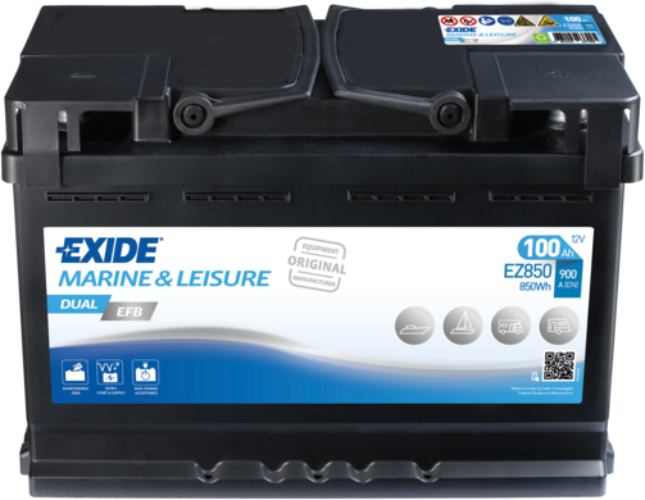
Marine and leisure electrical systems demand a battery capable of sustained deep cycling alongside robust cranking performance – a combination that standard automotive batteries cannot reliably deliver. The Exide EZ850 is a 12V 100Ah Dual EFB (Enhanced Flooded Battery) designed specifically to meet this dual requirement within a single battery bank, serving both engine starting and onboard consumer loads from one unit.
Exide Technologies engineers this battery using Enhanced Flooded Battery construction, which incorporates a polyester scrim mat bonded to the active plate material. This reinforcement reduces active mass shedding during repeated charge and discharge cycles, extending service life under the partial state-of-charge conditions typical of marine leisure use. The EZ850 is suited to vessels running electrical winches, thrusters, and trolling motors, and is engineered to tolerate partial discharge without the irreversible sulphation that degrades conventional flooded batteries.
The EZ850 measures 353mm × 175mm – 190mm (L × W × H) and is housed in an L05 case. It delivers 900A CCA (EN) and 850Wh of energy capacity, with a rated capacity of 100Ah (C20). The hold-down type is B13 and polarity is standard (0). This product carries NCC Class B classification. No direct cross-reference numbers are listed; fitment should be confirmed against vessel battery tray dimensions and electrical specification before purchase.
This model sits within the Exide Dual EFB range. Related variants include EL700, EL752, EL754, EL800, EL954, EL955, EL1000, and EL1050, covering a range of capacities for different vessel configurations. The EZ600 offers a lower-capacity alternative within the same EZ series.
The EZ850 is supplied with a 2-year manufacturer warranty. Standard delivery: 1–3 working days within UK mainland. 30-day returns.
The Exide Dual battery range is designed to supply power for boats with one battery bank for all consumers. It is also suitable for additional batteries used for electrical winches, thrusters, and trolling motors. The batteries are partially discharged during use. The Dual’s construction, together with the good recharging procedure, is the key to providing the best result and service life duration. Enhanced Flooded Battery • Extra start & supply • Maintenance free • Maximum charge acceptance
Key Feature:Designed for Leisure applications, balancing dependable starting with steady power delivery.
Uses:PartsForMachines is a premier e-commerce platform, founded in 2019 in Warwickshire, UK, specialising in aftermarket parts and services for construction, agriculture, and industrial machinery. We offer an extensive catalogue of over 500,000 products. Standard delivery: 1–3 working days within UK mainland. We are proud to be an authorised distributor, giving customers extra confidence when purchasing genuine products from us. In addition, we provide a 30-day return policy for eligible items.
| Brand | Exide Technologies |
|---|---|
| Voltage | 12V |
| Capacity AH (C20) | 100Ah |
| Cold Cranking Amps (EN) | 900A |
| L × W × H | 353mm × 175mm × 190mm |
| Warranty period | 2 Years |
| Weight (Kg) | 25.5 |
| Capacity AH (C5) | |
| Capacity AH (C10) | |
| Capacity AH (C100) | |
| Marine Cranking Amps (MCA) | |
| Watt-Hours (WH) | 850 |
| Length (mm) | 353 |
| Width (mm) | 175 |
| Height Inc. Terminal (mm) | 190 |
| Terminal Placement | 0 |
| Terminal Type | |
| Hold Down | B13 |
| Case Size | L05 |
| ETN Number | |
| TTNR |
| Engine Parts | Product Number | Product Name | Recommended Units | Product Price |
|---|

Expert Guidelines for Preserving Your Heavy Equipment Battery Heavy machinery, including forklifts, bulldozers, and excavators, relies on robust batteries to minimize downtime and maximize operational availability. These batteries must endure even more challenging conditions than typical automotive batteries. Moreover,...
 Standard Delivery: £5.99
 Delivery Estimate: 3 to 5 working days
 Save Extra With 1 Offer
 Compare With Similar Items
Compare with Similar products
|

LED95 Varta Professional Dual Purpose EFB Battery 12V 95Ah - 930 095 085, 2 Years Warranty
£143.98
£141.16
2% OFF
|
|||
| Technical Specification | ||||
|---|---|---|---|---|
| PRODUCT NUMBER | LED95 | |||
| Voltage | 12 | |||
| Capacity (AH) | 95 | |||
| Cold Cranking Amps (EN1) | 850 | |||
| Terminal Type | 1 | |||
| Length | 353 | |||
| Width | 175 | |||
| Height | 190 | |||
| Show More | ||||
A. The Exide EZ850 has a rated capacity of 100Ah at the C20 discharge rate, meaning it can deliver 5 amps continuously over 20 hours before reaching its discharged threshold.
A. The EZ850 is rated at 900A CCA to the EN standard, providing reliable engine starting performance in cold conditions typical of UK and Northern European marine environments.
A. EFB stands for Enhanced Flooded Battery. A polyester scrim mat is bonded to the active plate material, reducing mass shedding during repeated cycling. This makes the EZ850 more durable than a standard flooded battery when subjected to the frequent partial discharge and recharge cycles common in marine leisure applications.
A. The EZ850 has standard polarity (polarity code 0), meaning the positive terminal is positioned on the left when the battery is viewed from the front with terminals facing upward. Confirm terminal layout against your vessel's existing wiring before installation.
A. The battery measures 353mm in length, 175mm in width, and 190mm in height including terminals. It is housed in an L05 case with a B13 hold-down type. These dimensions should be verified against the battery tray on your vessel before ordering.
A. The EZ850 is certified to NCC Class B. The National Caravan Council battery classification scheme rates batteries on their suitability for leisure use. Class B indicates the battery is suitable for moderate leisure demands and provides a standardised benchmark for comparing batteries across manufacturers.
A. The EFB technology used in the EZ850 is capable of supporting start-stop functionality; however, suitability for a specific start-stop system must be verified against the product label and the vessel manufacturer's battery specification. Do not assume compatibility without confirming the required battery technology and capacity for your application.
A. Yes. Related models within the Exide Dual EFB and EZ ranges include EL700, EL752, EL754, EL800, EL954, EL955, EL1000, EL1050, and EZ600, covering a range of capacities and dimensions to suit different vessel battery tray configurations and electrical load requirements.
A. The EZ850 is dispatched via standard parcel delivery. Orders to UK mainland addresses are typically delivered within 1–3 working days. A 30-day returns policy applies. Delivery timescales to offshore, Highland, or non-mainland UK destinations may differ; contact PartsForMachines for confirmation before ordering.
A. The EZ850 carries a Watt-Hour rating of 850Wh. This figure represents the total energy the battery can deliver and is particularly useful when calculating how long onboard consumers — such as navigation electronics, lighting, or bilge pumps — can run from the battery without engine charging.
By sharing your email, you agree to our privacy policy & terms of service


 Question about this product? Click here


 .png)


