Cart


 POPULAR CATEGORY


| SERVICE | DELIVERY PRICE | DELIVERY TIME |
|---|---|---|
| Standard Delivery | £19.95 | 7 to 10 working days |
| SERVICE | DELIVERY PRICE | DELIVERY TIME |
|---|---|---|
| Standard Delivery | £19.95 | 7 to 10 working days |
| SERVICE | DELIVERY PRICE | DELIVERY TIME |
|---|---|---|
| Standard Delivery | £7.99 | 3 to 5 working days |
| SERVICE | DELIVERY PRICE | DELIVERY TIME |
|---|---|---|
| Standard Delivery | £7.99 | 5 to 7 working days |
| SERVICE | DELIVERY PRICE | DELIVERY TIME |
|---|---|---|
| Standard Delivery | £7.99 | 7 to 10 working days |
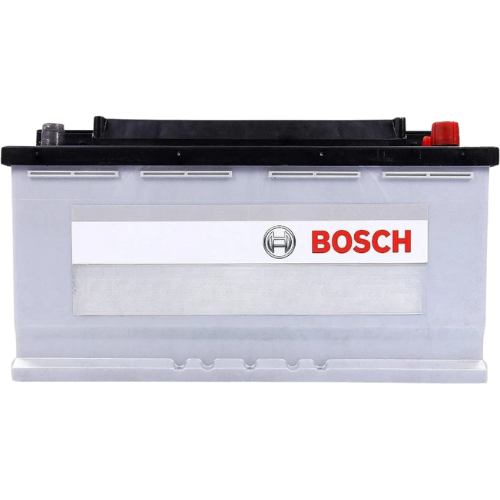
Heavy-duty commercial vehicles demand a battery capable of sustained high-load performance across extended service cycles. The Bosch T5 077 HDE Truck Battery (12V, 180Ah, 1000A CCA) is engineered specifically for demanding truck and commercial fleet applications where reliable cold-start performance and deep-cycle durability are non-negotiable operational requirements.
Built on Bosch's proprietary PowerFrame? grid technology, the T5 range delivers superior charge acceptance, reduced internal resistance, and enhanced deep-cycle resistance compared to conventional lead-acid constructions. The PowerFrame? design optimises current flow across the plate surface, improving both cranking performance and long-term capacity retention under heavy cyclic use – precisely the conditions encountered in commercial transport operations.
The T5077 is dimensioned at 513mm × 222mm – 223mm (L × W × H) and weighs 44.14kg, with a Type 1 terminal configuration, B00 hold-down, and polarity code 3. It cross-references directly against the 629SHD battery type. Start-stop system compatibility is not confirmed for this unit; refer to the product label for definitive guidance. IP rating, MCA, and Watt-Hour figures are not applicable to this specification.
This battery is available within a broader T5 HDE commercial range, including adjacent variants T5075 and T5080, as well as the T4 and T3 series for differing capacity and application requirements." Supplied with a 2-year warranty covering defects in materials and workmanship under standard commercial operating conditions. "Delivery: pallet shipment, typically 3–5 working days within UK mainland. Contact PartsForMachines for delivery quote. 30-day returns.
T5: Reliability from start to arrival The Bosch T5 batteries are equipped with the PowerFrame® technology – for high battery performance and high reliability. T5 convinces through maximum performance and deep-cycle resistance. It was especially developed for high energy requirements and frequent discharges.
Key Feature:Developed by Bosch as a 12.0 1 battery, offering stable energy output, dependable starting power, and compatibility across general automotive and light commercial applications.
Uses:PartsForMachines is a premier e-commerce platform, founded in 2019 in Warwickshire, UK, specialising in aftermarket parts and services for construction, agriculture, and industrial machinery. We offer an extensive catalogue of over 500,000 products. Standard delivery: 1–3 working days within UK mainland. We are proud to be an authorised distributor, giving customers extra confidence when purchasing genuine products from us. In addition, we provide a 30-day return policy for eligible items.
Fitment Warning:You must check your current battery against the specifications of this battery before ordering to ensure that this is the correct battery for your vehicle. Check battery technology, dimensions, terminal type, polarity, capacity (AH) and cranking performance (CCA). We cannot guarantee correct fitment under any circumstances.
| Brand | Bosch |
|---|---|
| Voltage | 12V |
| Capacity AH (C20) | 180Ah |
| Cold Cranking Amps (EN) | 1000A |
| L × W × H | 513mm × 222mm × 223mm |
| Warranty period | 2 Years |
| Weight (Kg) | 44.14 |
| Capacity AH (C5) | |
| Capacity AH (C10) | |
| Capacity AH (C100) | |
| Marine Cranking Amps (MCA) | |
| Watt-Hours (WH) | |
| Length (mm) | 513 |
| Width (mm) | 222 |
| Height Inc. Terminal (mm) | 223 |
| Terminal Placement | 3 |
| Terminal Type | 1 |
| Hold Down | B00 |
| Case Size | |
| ETN Number | 680108100 |
| TTNR | 0092T50770 |
| Engine Parts | Product Number | Product Name | Recommended Units | Product Price |
|---|

Expert Guidelines for Preserving Your Heavy Equipment Battery Heavy machinery, including forklifts, bulldozers, and excavators, relies on robust batteries to minimize downtime and maximize operational availability. These batteries must endure even more challenging conditions than typical automotive batteries. Moreover,...
 Standard Delivery: £7.99
 Delivery Estimate: 3 to 5 working days
 Save Extra With 1 Offer
 Compare With Similar Items
Compare with Similar products
|
||||
| Technical Specification | ||||
|---|---|---|---|---|
| PRODUCT NUMBER | YBX1629 | YBX1626 | ||
| Voltage | 12 | 12 | ||
| Capacity (AH) | 180 | 180 | ||
| Hold Down | N | B3 | ||
| Cold Cranking Amps (EN1) | 1100 | 1100 | ||
| Terminal Type | T1 | T1 | ||
| Cell Layout | 3 | 4 | ||
| Length | 513 | |||
| Width | 223 | 223 | ||
| Height | 223 | 223 | ||
| Show More | ||||
A. The Bosch T5077 is a 12-volt battery with a rated capacity of 180Ah (C20) and a Cold Cranking Amps (CCA, EN) rating of 1000A, making it suitable for high-demand commercial and heavy goods vehicle applications.
A. The T5077 measures 513mm in length, 222mm in width, and 223mm in height (including terminals). It weighs 44.14kg. These dimensions correspond to the 629SHD battery group size.
A. The T5077 uses a Type 1 terminal configuration with a B00 hold-down arrangement and polarity code 3. Verify compatibility with your vehicle's terminal layout and hold-down system before fitting.
A. The Bosch T5077 cross-references to battery type 629SHD. It is also identified by Bosch part number 0092T50770. This cross-reference can be used to confirm compatibility with existing fitment records.
A. Start-stop system compatibility has not been confirmed for the T5077. Refer directly to the product label supplied with the battery for definitive guidance on start-stop application suitability.
A. The T5077 is engineered for heavy-duty commercial vehicle use, including trucks, HGVs, and fleet vehicles requiring high cranking performance and robust deep-cycle capability. Always verify fitment against your vehicle's battery specification or consult PartsForMachines if unsure.
A. Yes. Adjacent T5 HDE variants include the T5075 (PID000199723) and T5080 (PID000199725). The T4 series (T4075 through T4080) and T3 series (T3040, T3041, T3054) are also available for differing capacity and application requirements.
A. The T5077 is supplied with a 2-year warranty covering defects in materials and workmanship under standard commercial operating conditions. Retain proof of purchase for the duration of the warranty period.
A. The T5077 is dispatched via pallet shipment due to its weight and size, with delivery typically within 3–5 working days to UK mainland addresses. Contact PartsForMachines directly for a delivery quote. A 30-day returns policy applies.
A. The T5 range incorporates Bosch's PowerFrame® grid technology, which optimises current flow across the battery plate surface. This results in improved charge acceptance, reduced internal resistance, and enhanced deep-cycle resistance — characteristics particularly beneficial in commercial vehicle and fleet operation.
By sharing your email, you agree to our privacy policy & terms of service

 Question about this product? Click here