Cart


 POPULAR CATEGORY


 ADD TO CART


| SERVICE | DELIVERY PRICE | DELIVERY TIME |
|---|---|---|
| Standard Delivery | £19.95 | 7 to 10 working days |
| SERVICE | DELIVERY PRICE | DELIVERY TIME |
|---|---|---|
| Standard Delivery | £19.95 | 7 to 10 working days |
| SERVICE | DELIVERY PRICE | DELIVERY TIME |
|---|---|---|
| Standard Delivery | £7.99 | 3 to 5 working days |
| SERVICE | DELIVERY PRICE | DELIVERY TIME |
|---|---|---|
| Standard Delivery | £7.99 | 5 to 7 working days |
| SERVICE | DELIVERY PRICE | DELIVERY TIME |
|---|---|---|
| Standard Delivery | £7.99 | 7 to 10 working days |
Product Number: DK820
Variations
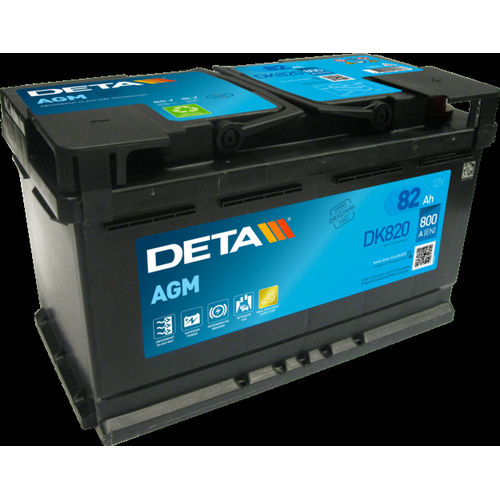
Modern start-stop vehicles place exceptional demands on the battery, cycling through dozens of engine-off events per journey whilst simultaneously powering climate control, infotainment and safety systems at idle. The DK820 operates at 12V. The Deta DK820 AGM Car Battery is engineered to meet precisely these conditions, delivering 82Ah capacity and 800A cold cranking amps (EN) within the Type 115AGM format. Deta's continuous investment in research and development underpins this battery's construction. An innovative framed grid design reinforces the active material throughout the charge and discharge cycles that characterise stop-start operation, maintaining capacity retention and cranking reliability over an extended service life. This makes it equally suited to vehicles with regenerative braking and advanced energy management systems. The DK820 fits the Type 115AGM group, measuring 315 mm – 175 mm – 190 mm (L × W × H) in an L04 case with polarity 0 (positive terminal left). Hold-down type is B13. The battery weighs 23.3 kg. It crosses directly to the 115AGM reference and is compatible with vehicles requiring Group 115AGM fitment. The DK820 is one of several capacities in the Deta AGM range; sister models DK720 (72Ah), DK960 (96Ah) and DK1060 (106Ah) are available for differing vehicle requirements. All are purpose-built for OE-equivalent performance in aftermarket applications. The DK820 is covered by a 3-year warranty, providing assurance of long-term reliability in demanding start-stop applications. Standard delivery: 1–3 working days within UK mainland. 30-day returns.
For toughest electrical needs of Start-Stop vehicles. Continuous investments in RD have allowed Deta to propose the latest innovative AGM batteries from OE to the aftermarket, too. They feature a new innovative framed grid, perfect for advanced Start-Stop systems where the battery needs to be quickly recharged through the energy provided by the regenerative braking system.
Key Feature:Engineered for modern passenger vehicles, providing reliable starting power, voltage stability, and long-term durability to support daily commuting and standard automotive electrical demands.
Uses:PartsForMachines is a premier e-commerce platform, founded in 2019 in Warwickshire, UK, specialising in aftermarket parts and services for construction, agriculture, and industrial machinery. We offer an extensive catalogue of over 500,000 products. Standard delivery: 1–3 working days within UK mainland. We are proud to be an authorised distributor, giving customers extra confidence when purchasing genuine products from us. In addition, we provide a 30-day return policy for eligible items.
Fitment Warning:You must check your current battery against the specifications of this battery before ordering to ensure that this is the correct battery for your vehicle. Check battery technology, dimensions, terminal type, polarity, capacity (AH) and cranking performance (CCA). We cannot guarantee correct fitment under any circumstances.
| Brand | Deta |
|---|---|
| Voltage | 12V |
| Capacity AH (C20) | 82Ah |
| Cold Cranking Amps (EN) | 800A |
| L × W × H | 315mm × 175mm × 190mm |
| Warranty period | 3 Years |
| Weight (Kg) | 23.3 |
| Capacity AH (C5) | |
| Capacity AH (C10) | |
| Capacity AH (C100) | |
| Marine Cranking Amps (MCA) | |
| Watt-Hours (WH) | |
| Length (mm) | 315 |
| Width (mm) | 175 |
| Height Inc. Terminal (mm) | 190 |
| Terminal Placement | 0 |
| Terminal Type | |
| Hold Down | B13 |
| Case Size | L04 |
| ETN Number | |
| TTNR |
| Engine Parts | Product Number | Product Name | Recommended Units | Product Price |
|---|

Expert Guidelines for Preserving Your Heavy Equipment Battery Heavy machinery, including forklifts, bulldozers, and excavators, relies on robust batteries to minimize downtime and maximize operational availability. These batteries must endure even more challenging conditions than typical automotive batteries. Moreover,...
 Standard Delivery: £7.99
 Delivery Estimate: 3 to 5 working days
 Save Extra With 1 Offer
 Compare With Similar Items
Compare with Similar products
|
|||||
| Technical Specification | |||||
|---|---|---|---|---|---|
| PRODUCT NUMBER | YBX9115 | YBX9096 | YBX9019 | EK700 | EK720 |
| Voltage | 12 | 12 | 12 | 12 | 12 |
| Capacity (AH) | 80 | 70 | 95 | 70 | 72 |
| Hold Down | B3 | B3 | B3 | ||
| Cold Cranking Amps (EN1) | 800 | 760 | 850 | 720 | 760 |
| Terminal Type | T1 | T1 | T1 | ||
| Length | 317 | 278 | 353 | 278 | 278 |
| Width | 175 | 175 | 175 | 175 | 175 |
| Height | 190 | 190 | 190 | 190 | 190 |
| Show More | |||||
A. The Deta DK820 is rated at 800A cold cranking amps measured to the EN standard, providing reliable engine starting in cold weather conditions.
A. Yes. The DK820 is an AGM battery purpose-built for start-stop systems. Its framed grid construction is designed to withstand the repeated charge and discharge cycles generated by stop-start operation and regenerative braking systems.
A. The DK820 measures 315 mm in length, 175 mm in width and 190 mm in height including the terminals, fitting the Type 115AGM battery group and L04 case.
A. The DK820 has polarity 0, meaning the positive terminal is positioned on the left-hand side when viewed from the front of the battery.
A. The DK820 crosses directly to the 115AGM battery reference. It is compatible with applications specifying a Type 115AGM group battery.
A. The DK820 uses a B13 hold-down configuration. Please verify that your vehicle's battery tray and clamp bracket are compatible with this hold-down type before fitting.
A. The DK820 is covered by a 3-year manufacturer's warranty, providing assurance of performance and reliability for start-stop vehicle applications.
A. The DK820 has a capacity of 82Ah (C20). Alternative capacities in the Deta AGM range include the DK720 (72Ah), DK960 (96Ah) and DK1060 (106Ah), allowing selection to match the specific requirements of your vehicle.
A. AGM stands for Absorbent Glass Mat. In an AGM battery, the electrolyte is absorbed into fibreglass matting rather than free-flowing, making the battery spill-proof and vibration-resistant. AGM technology also supports the high charge acceptance rates required by regenerative braking systems and the deep cycling demands of start-stop operation, making it the OE-specified chemistry for many modern vehicles.
A. Standard delivery takes 1–3 working days to addresses within UK mainland. A 30-day returns policy applies. Please ensure the battery is unused and in its original packaging when returning.
By sharing your email, you agree to our privacy policy & terms of service


 Question about this product? Click here