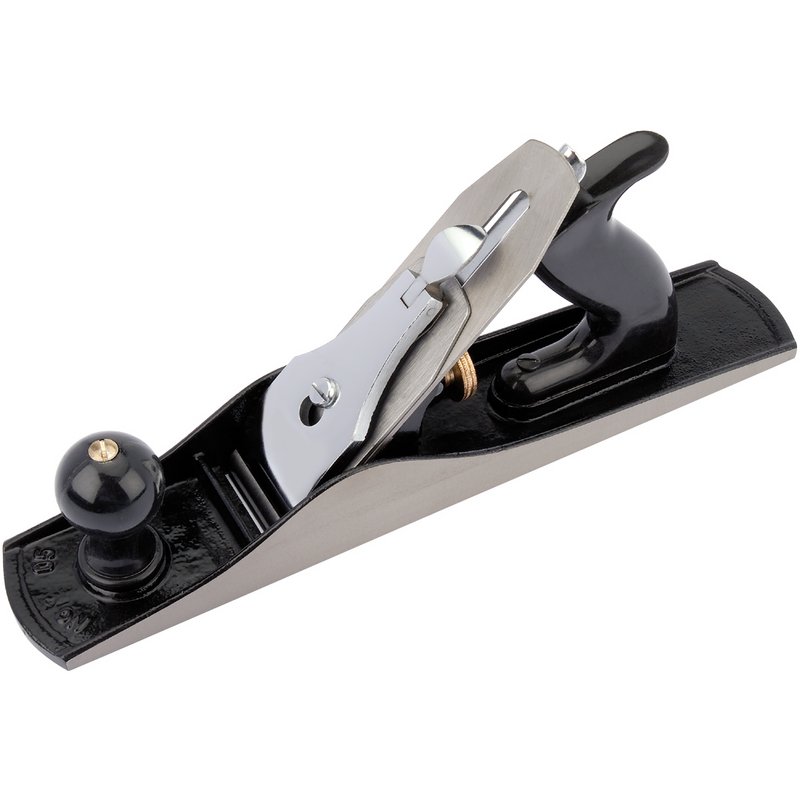
A plane and a rasp remove material in different ways and leave different surfaces. A plane blade takes a continuous shaving and leaves a smooth face. A rasp tears individual chips out, which removes material faster and leaves a surface that has to be finished afterwards. Choosing between them is a decision about the finish rather than about speed alone.
A multi-rasp plane sits between the two, using a perforated blade that cuts like a rasp and clears the waste through itself rather than clogging. That is what lets it be worked continuously on softwood and board where a rasp would fill and stop. It also means a multi-rasp blade is replaced rather than sharpened when it stops cutting.
The adjustable handle changes the angle of attack rather than the depth. Setting the handle differently changes how the blade meets the surface, which is what allows the same tool to work a flat face and a curve without changing blades. Blade type is stated per plane rather than being inferred from the body.
Hand drills and a ratchet brace sit on the same leaf as the other tools worked by hand rather than by power. An 8mm chuck covers general drilling, and a brace gives far more torque at low speed for a large bit in timber. Send the work to 07754288583 on WhatsApp. A pin setting tool sits on the same leaf for fixings set by hand rather than driven. A chuck drill and a brace cover the same holes at different speeds and torques.
| Model No | AK6092 |
|---|---|
| Blade Width(s) | 35mm |
| Brand | Sealey |
| Length | 160mm |
| Nett Weight | 0.66kg |
| Model No | AK6093 |
|---|---|
| Blade Width(s) | 50mm |
| Brand | Sealey |
| Length | 250mm |
| Nett Weight | 1.80kg |
By sharing your email, you agree to our privacy policy & terms of service