


 Filters


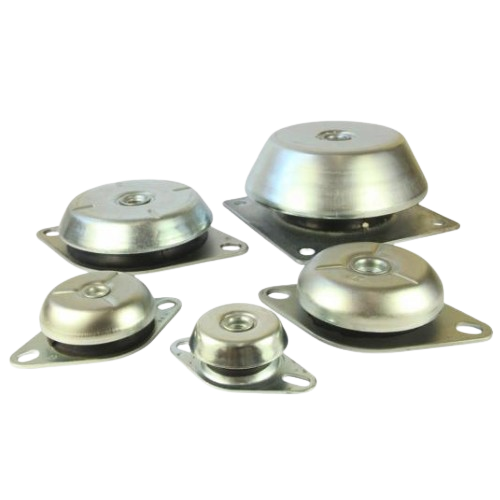
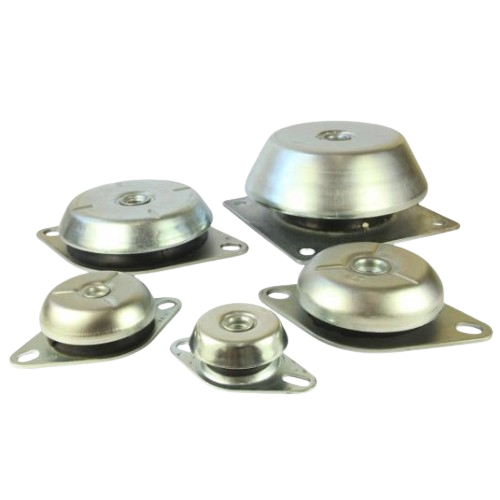
A captive mount makes one promise the rest of the estate does not make: if the rubber ever fails, the load does not drop. The metalwork of the mount interlocks through the rubber, so a failed mount sags and complains but keeps its hold on the machine, which is why moving plant, overhead kit and marine installations specify captive and failsafe forms, and why this shelf of 182 mounts runs to the heaviest ratings in the estate.
The square flanged captive mounts carry the top of the range, threads from M20 to M24 and stated loads running from 900 kilograms through 2000 on the 180 series to 4000 and 5000 kilograms on the largest 220 forms, with heavy duty variants of the same footprints rated differently by compound. Below them the family runs down through M16, M12 and M10 threads to captive mounts for ordinary machine weights, all of them picked by the estate's standing triad of form, thread and load, with the failsafe promise held at every rating.
The arithmetic sharpens at these weights: the machine's mass divided across its mounting points, with real margin for shock and for the load shifting in motion, gives each mount's working share, and the compound grading means the same body often carries two or three ratings, so the listing's stated number, never the footprint, is what decides the pick.
Thread and load typed into search cut the shelf down fast, the code on a worn mount finds its replacement directly, and an installation's weight, mounting pattern and duty, static, mobile or marine, over WhatsApp on 07754288583 comes back with the mount named, the arithmetic done and the failsafe question answered honestly for the application.

| Thread size | M16 / M12 |
|---|---|
| Overall length (mm) | 110 |

| Height | 100mm |
|---|---|
| Stud Size | M12 |

| Thread size | M20 |
|---|---|
| Overall length (mm) | 145 |

| Thread size | M16 |
|---|---|
| Overall length (mm) | 110 |

| Height | 110mm |
|---|---|
| Stud Size | M16 |

| Height | 110mm |
|---|---|
| Stud Size | M12-M16 |

| Outer Dimensions (A) | 83mm |
|---|---|
| Flange Height (B) | 35mm |
| Thread size (P) | M12 |
| Mounting Hole Dimensions (F x M) | 11mm |
| Center Distance (CF) | 108-110mm |

| Outer Dimensions (A) | 83mm |
|---|---|
| Flange Height (B) | 35mm |
| Thread size (P) | M10 |
| Mounting Hole Dimensions (F x M) | 11mm |
| Center Distance (CF) | 108-110mm |

| Outer Dimensions (A) | 83mm |
|---|---|
| Flange Height (B) | 35mm |
| Thread size (P) | M10 |
| Mounting Hole Dimensions (F x M) | 11mm |
| Center Distance (CF) | 108-110mm |
| Outer Dimensions (A) | 83mm |
|---|---|
| Flange Height (B) | 35mm |
| Thread size (P) | M12 |
| Mounting Hole Dimensions (F x M) | 11mm |
| Center Distance (CF) | 108-110mm |

| Outer Dimensions (A) | 83mm |
|---|---|
| Flange Height (B) | 35mm |
| Thread size (P) | M12 |
| Mounting Hole Dimensions (F x M) | 11mm |
| Center Distance (CF) | 108-110mm |

| Outer Dimensions (A) | 77mm |
|---|---|
| Flange Height (B) | 30mm |
| Thread size (P) | M10 |
| Mounting Hole Dimensions (F x M) | 9mm |
| Center Distance (CF) | 108-110mm |

| Outer Dimensions (A) | 77mm |
|---|---|
| Flange Height (B) | 30mm |
| Thread size (P) | M12 |
| Mounting Hole Dimensions (F x M) | 9mm |
| Center Distance (CF) | 108-110mm |

| Outer Dimensions (A) | 77mm |
|---|---|
| Flange Height (B) | 30mm |
| Thread size (P) | M12 |
| Mounting Hole Dimensions (F x M) | 9mm |
| Center Distance (CF) | 108-110mm |
| Outer Dimensions (A) | 77mm |
|---|---|
| Flange Height (B) | 30mm |
| Thread size (P) | M10 |
| Mounting Hole Dimensions (F x M) | 9mm |
| Center Distance (CF) | 108-110mm |

| Overall length / diameter A (mm) | 83 |
|---|---|
| Width / dimension B (mm) | 35 |
| Pitch / dimension P (mm) | M10 / M12 |
| Fixing hole F (mm) / Thread / stud size M | 11ø |
| Across flats / clearance CF (mm) | 108 - 110 |

| Overall length / diameter A (mm) | 77 |
|---|---|
| Width / dimension B (mm) | 30 |
| Pitch / dimension P (mm) | M10 / M12 |
| Fixing hole F (mm) / Thread / stud size M | 9ø |
| Across flats / clearance CF (mm) | 108 - 110 |

| Outer Dimensions (A) | 63mm |
|---|---|
| Flange Height (B) | 35mm |
| Thread size (P) | M12 |
| Mounting Hole Dimensions (F x M) | 9x14mm |
| Center Distance (CF) | 76-90mm |

| Outer Diamensions (A) | 63mm |
|---|---|
| Flange Height (B) | 35mm |
| Thread size (P) | M10 |
| Mounting Hole Dimensions (F x M) | 9x14mm |
| Center Distance Dimensions(CF) | 76-90mm |

| Outer Dimensions (A) | 63mm |
|---|---|
| Flange Height (B) | 35mm |
| Thread size (P) | M12 |
| Mounting Hole Dimensions (F x M) | 9x14mm |
| Center Distance (CF) | 76-90mm |

| Outer Dimensions (A) | 63mm |
|---|---|
| Flange Height (B) | 35mm |
| Thread size (P) | M10 |
| Mounting Hole Dimensions (F x M) | 9x14mm |
| Center Distance (CF) | 76-90mm |

| Outer Dimensions (A) | 63mm |
|---|---|
| Flange Height (B) | 35mm |
| Thread size (P) | M12 |
| Mounting Hole Dimensions (F x M) | 9x14mm |
| Center Distance (CF) | 76-90mm |

| Outer Dimensions (A) | 63mm |
|---|---|
| Flange Height (B) | 35mm |
| Thread size (P) | M12 |
| Mounting Hole Dimensions (F x M) | 9x14mm |
| Center Distance (CF) | 76-90mm |

| Outer Dimensions (A) | 63mm |
|---|---|
| Flange Height (B) | 35mm |
| Thread size (P) | M10 |
| Mounting Hole Dimensions (F x M) | 9x14mm |
| Center Distance (CF) | 76-90mm |

| Outer Dimensions (A) | 63mm |
|---|---|
| Flange Height (B) | 35mm |
| Thread size (P) | M10 |
| Mounting Hole Dimensions (F x M) | 9x14mm |
| Center Distance (CF) | 76-90mm |

| Outer Dimensions (A) | 63mm |
|---|---|
| Flange Height (B) | 35mm |
| Thread size (P) | M10 |
| Mounting Hole Dimensions (F x M) | 9x14mm |
| Center Distance (CF) | 76-90mm |

| Outer Dimensions (A) | 63mm |
|---|---|
| Flange Height (B) | 35mm |
| Thread size (P) | M10 |
| Mounting Hole Dimensions (F x M) | 9x14mm |
| Center Distance (CF) | 76-90mm |

| Outer Dimensions (A) | 63mm |
|---|---|
| Flange Height (B) | 35mm |
| Thread size (P) | M12 |
| Mounting Hole Dimensions (F x M) | 9x14mm |
| Center Distance (CF) | 76-90mm |

| Overall length / diameter A (mm) | 63 |
|---|---|
| Width / dimension B (mm) | 35 |
| Pitch / dimension P (mm) | M10 / M12 |
| Fixing hole F (mm) | 9 |
| Thread / stud size M | 14 |

| Thread size | M20 |
|---|---|
| Overall length (mm) | 145 |
By sharing your email, you agree to our privacy policy & terms of service


 Cart
Cart


 POPULAR CATEGORY


